22
2026When a bride walks into my studio for the first time, she often speaks about lace.
She shows me references filled with intricate embroidery, delicate beadwork, dramatic sleeves, and flowing trains. The conversation begins with what is visible.
But as a couture designer, my mind goes somewhere else first.
I think about what is invisible.
Because a wedding gown is not defined by what you see on the surface. It is defined by what supports it underneath.
The truth I have learned after years of designing bridal couture is simple:
A wedding gown can have the most beautiful lace in the world, but if the internal construction is weak, the silhouette collapses, posture suffers, and the bride begins to feel it within minutes.
On the other hand, when the structure is built correctly, even the simplest gown feels powerful, composed, and timeless.
This is why, in my atelier, construction always comes before decoration.
When we talk about structure, we are talking about the internal architecture of the gown.
This includes:
Corsetry
Boning
Seams and panelling
Lining layers
Waist support
Pattern shaping
These elements are not visible, but they determine everything about how the gown fits, moves, and feels.
A wedding gown is not just stitched it is engineered.
Especially in Chennai, where weddings can be long and the climate can be warm, internal construction becomes even more important.
Without proper structure, even a visually stunning gown can feel unstable.
Corsetry is the foundation of most couture bridal designs.
Many brides misunderstand corsetry as something restrictive. In reality, when designed correctly, corsetry provides support not pressure.
It helps:
Define the waistline
Support the bust
Maintain posture
Stabilize the bodice
In a long ceremony, such as a Christian wedding in a church setting, this support becomes essential.
The bride stands for extended periods. She walks slowly down the aisle. She may kneel or sit during the ceremony.
Without corsetry, the gown can shift, crease, or lose shape.
With proper corsetry, the silhouette remains clean and composed.
The bride feels supported from within.
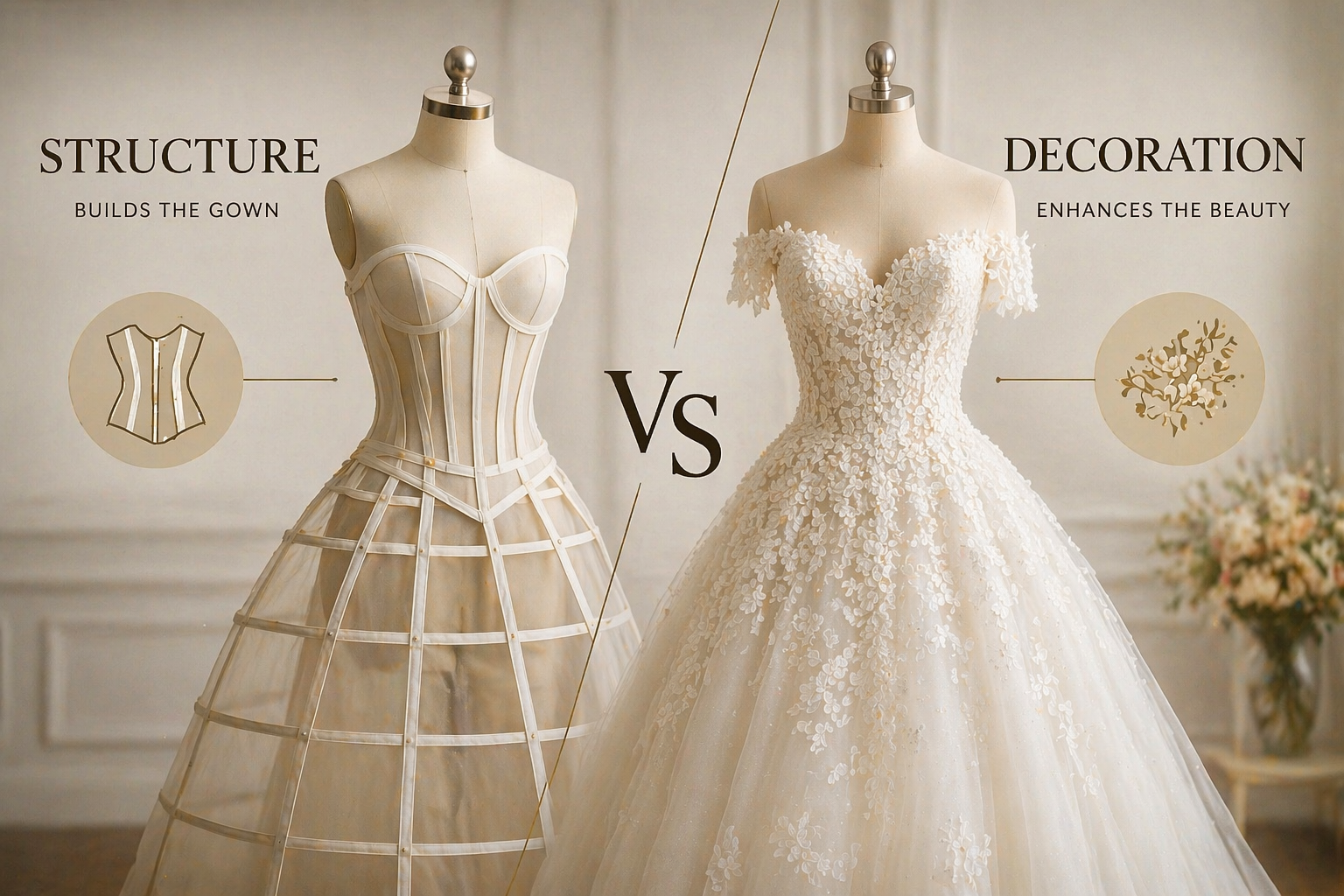
It is important to understand the difference between decoration and structure.
Decoration includes:
Lace
Beading
Embroidery
Surface detailing
Structure includes:
Boning
Internal seams
Lining
Pattern shaping
Decoration is what you see.
Structure is what holds everything together.
In many ready-made designs, decoration is used to create visual impact, sometimes compensating for weak structure.
In couture, we do the opposite.
We build the structure first, ensuring the gown fits perfectly and supports the body. Then we layer decoration in a way that enhances the silhouette.
This approach creates a gown that feels balanced, not forced.
In my design process, the first fittings are never about lace.
They are about structure.
I focus on:
How the bodice sits on the torso
Where the waistline aligns
How the seams shape the body
How the skirt begins and flows
Only after the structure is perfected do we begin adding surface details.
This ensures that decoration enhances the design rather than hiding flaws.
A well-constructed wedding gown does not need excessive embellishment.
Its elegance comes from precision.
A wedding ceremony is not a short event.
In Chennai, especially in traditional settings, ceremonies can last several hours.
The bride moves, stands, sits, and interacts with guests throughout.
This is where structure becomes critical.
In a Christian wedding ceremony, this moment carries emotional and visual significance.
A structured wedding gown ensures that the silhouette remains balanced and the bodice stays in place.
Every step looks natural and composed.
Comfort is often associated with softness, but in bridal design, comfort comes from support.
A well-constructed gown distributes weight evenly across the body.
Structure reduces strain and allows the bride to move freely while maintaining elegance.
Photography reveals everything.
A well-structured gown holds its shape from every angle.
Structure ensures balanced proportions and clean lines.
Couture design is often compared to architecture.
Every element has a purpose. Every seam contributes to the overall structure.
A wedding gown is not assembled it is built.
Trends change. Decoration styles evolve.
But structure remains timeless.
A well-constructed wedding gown will look elegant today, tomorrow, and decades later.
That feeling comes from structure.
After years of working with brides, I have come to believe that the most beautiful wedding gown is not the one with the most decoration.
It is the one that is built with care.
Structure is what allows a gown to move gracefully, photograph beautifully, and support the bride throughout her day.
Decoration is important but it is secondary.
When structure is right, everything else falls into place.
1. What is wedding gown structure?
Wedding gown structure refers to the internal construction of the gown, including corsetry, boning, seams and lining that support the silhouette.
2. Why is structure more important than decoration?
Structure determines fit, comfort and posture. Decoration enhances appearance but cannot compensate for poor construction.
3. Does every wedding gown need corsetry?
Not every gown requires heavy corsetry, but most structured bridal designs include some level of internal support for stability and shape.
4. How does structure affect comfort?
A well-structured gown distributes weight evenly and provides support, which reduces discomfort during long ceremonies.
5. Is structure important for church ceremonies?
Yes. In a Christian wedding ceremony, where the bride stands and moves for extended periods, structure helps maintain posture and confidence.
Luxury wedding gowns in Chennai, Christian bridal gowns, reception gowns, groom tuxedos, and bespoke wedding suits - handcrafted by La Fantaisie Wedding Atelier. We design Christian wedding gowns, white bridal gowns, custom wedding dresses, luxury reception gowns, groom tuxedos, wedding suits, and coordinated couple for brides and grooms across Chennai and Tamil Nadu.
Every gown and tuxedo is created under the artistic direction of Rachel J. Amirtharaj, known for corsetry, sculpted silhouettes, hand embellishment, and precision tailoring-making La Fantaisie one of the best wedding gown designers in Chennai and a rising name among top Christian bridal designers in India.
For brides searching for Christian wedding gowns Chennai, bridal gowns Chennai, designer wedding gowns Chennai, and grooms seeking luxury tuxedos Chennai or wedding suits Chennai, La Fantaisie stands as the trusted house for couples who want handcrafted elegance for their once-in-a-lifetime day.